Lower Saxony and Bremen, Germany
Information
Lower Saxony and Bremen
Lower Saxony: Steed and horseman, mountains, coasts and golf
Lower Saxony, the German state which carries the white horse with the red coat of arms, lies in the large charming region between the Ems and the Elbe, the high seas climate of the North Sea and the mountain tops of the Harz region. Like pearls on a chain, the seven Eastern Frisian Islands rise up in the southern North Sea before the mainland. Each island is charming as a recognised North Sea spa through its incomparable uniqueness, both as a spa island as well as a holiday island. A lot of good golf can be played upon the large mainland between the Ems and the Elbe, between the coast and the mountains.
The regions in Lower Saxony offer a variety of landscapes and places to live. From the North Sea and its islands via the Lüneburg Heath to the highlands in the Harz, the northwestern German state shows its many facets. At 230 km², the Lüneburg Heath is the largest connected heath in western Europe. The romantic highlands of the Weser mountain land, with its gentle hills, owe its name to the Weser River. Along the Weser From Hann. Münden, the southern point of Lower Saxony, to Hamelin and then on to Bremen, a large section of the German Fairy Tale Road, quite beautiful historical cities with half-timbered buildings are lined up like pearls upon a chain.
Travel through this land which boasts over 40 therapeutic baths and spas for all possible health programmes and let’s unite beautiful landscapes and city experiences, culture and nature with health and golf.
The hare, the hedgehog and golf
Let’s start our Lower Saxony golf-cultural rally along the Elbe which separates the state from its northern and eastern neighbours. Travelling across the region north, west and east of the Hanseatic city of Hamburg which is described elsewhere in this magazine, the historical, natural (the Old Land, the largest fruit-growing area in northern Europe) and golfing highlights southwest and southeast of the Elbe cannot be ignored, but above all owing to the golfing greats located upon Lower Saxony terrain.
For example, in the Old Land south of the Elbe, the Swedish Kingdom’s coat of arms surprisingly greets one from the Town Hall in Stade – completed in the 17th Century. The old Swedish storehouse, constructed by Karl XII as the warehouse for his troops’ provisions, is today an important city and regional museum.
A few kilometres away lies Buxtehude which, like Stade, was under Swedish rule during a time in which the famous story of the hare and the hedgehog was created.
Right between the two cities, there lies the Buxtehude Golf Club, a course which is difficult and beautiful at the same time where one can often feel like one is either a hare or a hedgehog while playing – that is to say that the efforts of persuading the small golf ball into the hole can often be in vain.
A true golfing, historical and gastronomical feast for the eyes is the Deinster Mühle Golf Club golf course. Here, around a veritable old mill, a hospitable golf paradise has been created which likes to welcome the visitors in an especially friendly manner.
The golf course of the St. Dionys Golf Club lies in the middle of the heath. The magnificent 18-hole championship course offers high quality and is considered to be the best of the best in the North Heath.
Golfers as noblemen
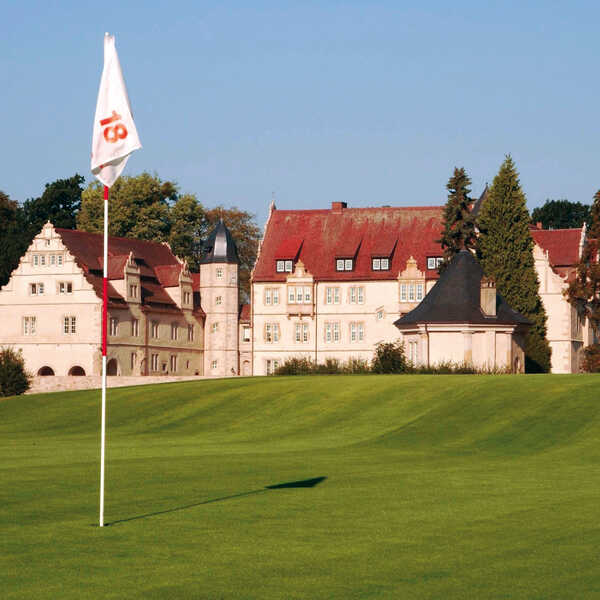
A little later and then somewhat farther east – and still along the Salt Road, one stumbles in Lüdersburg upon the breathtaking golf course of the Lüdersburg Castle Golf Club which is in the Clubhaus Group. In an almost pristine rural idyll, a veritable baron set about years ago to follow Molière and at least make the golfing bourgeois into noblemen. The Lüdersburg Castle golf course then developed, with the manor, the cavaliers’ homes and the one-time office building transformed into an apartment building, two magnificent golf courses (one with park land and one with a links design), great practice facilities, very good gastronomy, then facilities for holding weddings and conventions, and then finally into a genuine golf and holiday resort. It is considered to be one of the most celebrated courses in Germany.
Let us discuss Lüneburg and the Lüneburg Heath once again, the home of Hermann Löns and the Heidschnucken [type of sheep]: In this heath, an incomparable natural monument, there also lie cities such as the princely Celle or places like Schneverdingen – and magnificent golf courses such as an der Goehrde, the Hof Loh Course in Soltau, the am Hockenberg Golf & Country Club and then the outstanding Adendorf Golf Resort. With the Heath Golf Card, they are all connected with the Lüdersburg Castle Clubhaus golf course. This card makes it possible to play all of these heath golf courses at an extremely reasonable green fee.
Ansgar’s Mission, Emsland and Osnabrück’s Peace
Many centuries ago, long before the northern German Hanseatic League existed, the monk Ansgar from Bremen on the North Sea moved to the north and brought Christianity to the Vikings and their Scandinavian brothers – a great mission for Christianity in northern Europe began which can still be remembered today, along with its founder Ansgar, in the St. Petri Bremen Museum.
We will come back later to Bremen, the small divided city-state with a long history. However, first we will go further west into Oldenburger and Emsland. And one doesn’t have to travel far before one comes upon the Oldenburgian Golf Club in the Ammerland in Rastede with its 18 holes. At the Oldenburg Land Golf Club, there are still another 18 holes or at the Hude Golf Club in Ganderkesee where, upon ca. 80 ha, the ambitious golf will find both a public 9-hole course as well as an 18-hole championship course which offers varied golf even for experienced players. Now we are right in the middle of Friesland, can play the 18 holes at the Wilhelmshaven Golf Club in Wilhelmshaven and the 18 holes at the Ostfriesland Golf Club near Wiesmoor which, owing to the constant wind, have a particularly harsh and challenging appeal.
At the Papenburg Golf Club, we can observe from the fairways how the large cruise ships go down the Ems.
Our journey leads up the Ems. We visit the Düneburg Golf Club with its 18 and 4 holes, a very beautiful around an old moated castle and finish with the Emsland with 18 holes at the Emstal Golf Club near Lingen.
Upon the way back to Bremen, we stumble in the western corner of Lower Saxony upon Osnabrück which is not only the largest city in the northwestern part of Germany, but rather together with Münster which lies in the Westphalian section, the name of which will always be associated with the peace treaty which ended the 30 Years’ War in 1648. At that time, Osnabrück represented for Sweden the cradle to becoming a major power in that it grew greatly after the war. For five years, 150 representatives of the Protestant and Imperial powers under Swedish leadership had negotiated in Osnabrück and Münster before a compromise was found to end the war.
It doesn’t take much time today in order to go upon a golfing trip from the Lower Saxony North Sea coast to Oldenburg, into Emsland and finally to come to Osnabrück. In the area of Osnabrück – between the Wiehengebirge [name of mountains] and Teutoburg Forest, golf is actually quite in fashion: We begin with the Osnabrück Golf Club, the 18 holes of which have been even picturesquely built into the end moraine landscape and, owing to its abundance of variety, is also among the “Leading Golf Courses of Germany”.
The close proximity of the Teutoburg Forest and the historical battle against the Romans has ensured that one of the most beautiful golf courses (18/3 holes) near Ostercappeln is called the Varus Golf Club. Upon the way to the north, we pass Vechta, playing the 18 holes of the Vechta-Welpe Golf Course which are among the most beautiful courses in northern Germany and complete our visit to the Osnabrück country in western-southwestern Lower Saxony at the Thülsfeld Talsperre Golf Club which the 27 holes (of which 9 are public) in wonderfully pristine nature.
Fairy tale golf
Back in Bremen, in the small state associated with Bremerhaven which is situated on the Weser and the North Sea. Bremen’s Town Hall, exemplary for architectonic symbolism with regards to the idea of freedom, was built at the beginning of the 15th Century in Gothic style and renovated in the early 17th Century in the style of the Weser Renaissance. In 1404, the 5.50-metre-high Roland Statue made of stone upon the Market Square was erected in 1404 as the symbol of Hanseatic freedom. It is considered to be the oldest statue still on its original location in Germany (the Town Hall and the Roland Statue have been designated as UNESCO World Cultural Heritage Sites). Here – in this old Hanseatic city which is of great historical and cultural importance – one of the most beautiful and informative German tourist roads begins, the German Fairy Tale Road. The fairy tales of the Brothers Grimm (Sleeping Beauty, Snow White and the Seven Dwarfs, Puss in Boots, the Bremen Town Musicians and many others) are known throughout the world. Both brothers, who were born in Hanau, went to school in Kassel and at the Royal Library and then later taught in Göttingen as professors, collected the fairy tales from more than the previous 200 years and then widely disseminated them as “Kinder und Hausmärchen” [Children’s and Household Fairy Tales]. They have since been translated into 160 languages.
To honour the Brothers Grimm and the highlight sites of the fairy tales, the German Fairy Tale Road was brought to life as a Tourist Experience Road originating from Kassel during the 1970s. This road begins in Bremen, then travels over 600 kilometres to the south, combining many fairy tale landscapes and tourist as well as cultural highlights. Quite simply beautiful that most of these fairy tale locations can also be combined with the highlights of golfing. Thus, next off to fairy tale golf in Lower Saxony.
Let’s begin our trip with the Bremen Town Musicians, travel to the Rat Catchers of Hamelin, to Rapunzel and Sleeping Beauty, to the Lying Baron of Münchhausen, to Doctor Eisenbart, to Mrs. Holle and Max and Moritz – from Bremen to Hanau. Some side trips into the beautiful country of Lower Saxony are allowed owing to good golf and many other attractions.
Around Bremen, which is known for its town musicians, but also its very good wines, there are genuine golfing pearls. There is the zur Vahr Club which has even hosted the German Open Championships several times. There are the holes of Oberneuland, the beautiful fairways and greens of the Bremer Schweiz [Bremen Switzerland] Golf Club. A little farther away from the city, awaits you, dear visitors to Germany, the Syke Golf Club, the Achim Golf Club and the Steinhude Sea Golf Club on the Steinhude Sea.
Overall, you will be welcomed in a friendly manner. Even at the Verden Golf Club which is not only located directly along the confluence of the Aller and Weser, but rather also in close proximity to the large Verden recreational park along the Fairy Tale Road where many historical “fairy tale scenes” with eloquent figures and replications are resurrected again.
Before we reach the Bückeburg Hunters in Bückeburg upon the Fairy Tale Road, we should first turn to the east, travel through the southern heath, perhaps even visit the 700-year-old Celle residence city with the Herzogstadt [Ducal City] Celle Golf Club and its unique ensemble of bourgeois houses before we then directly approach the region of Hanover and the Lower Saxony capital city from the north. They can boast of a lot of history and culture, have held an expo and at least annually hold the largest trade fairs. However, the region and city of Hanover also has top-class golf courses – which we should now discuss.
Whether one travels from the north to the south or from the west to the east, the most important Autobahn and railway routes intersect in Hanover between Copenhagen and Rome and between Paris and Moscow. Hanover is a tourist destination: The Royal Gardens of Herrenhausen are unique in Germany. Baroque gardens which have remain unchanged for more than 300 years. The indoor rain forest, green abyss – green paradise. The Experience Zoo. The Maschsee for surfing, rowing, sailing and swimming. Hanover is a cultural city with an opera house, numerous galleries, theatres and exhibitions. The GOP, the Georgspalast, is considered to be one of the best varieté theatres in Germany. Museums such as the Sprengel Museum, which enjoy an international reputation, are other places to visit. Or: The New Town Hall: The enormous New Town Hall was built at the beginning of the last century in the stately style of the Wilhelminian Era. The cupola measures 98 metres to its gold-laden top.
The golf links of Hanover
However, a trip into the Hanover region also means special golfing opportunities. Around the city along the Leine River, golf has enjoyed a good and long tradition. Among the many courses such as the Hanover Golf Club in Garbsen, the Gleidingen Golf Club or Isernhagen, particularly the golf course of Rethmar Golf Links in the eastern part of the Lower Saxony capital city stands out. Here, in the interior land, Arnold Palmer realised a links course which is truly like a fairy tale that is nonetheless real, the greens of which (A 4 grass) are among the fastest in Europe. But continuing on playing golf, and not just anywhere, but rather at the Langenhagen Golf Club, the Burgwedel Golf Club and the Peine-Edemissen Golf Club. Hanover and its region absolutely appeal to many interests. Included among them is also quite good golf!
From the Rhetmar Golf Club which lies directly along the Middle Land Channel, one can travel upon the water to the Wolfsburg, visit the VW Auto City, even reside in the Auto City and then make the short trip to Braunschweig, the city of the Guelphs, which lies south of the Autobahn. Heinrich the Lion (1129 to 1195) loved the city and made it his residence. The charm of the city lies in the contrast between old and new, between the “traditional islands” with an old grove of trees and modern buildings. Following in the path of old kings, a walk through the city leads to the Burglöwen [Fortress Lion], the bronze king of the animals, which Heinrich had made as a symbol of his power in 1166 and then onwards to the Romanesque-Gothic St. Blasius Cathedral. In the shadows of the Guelph Lion and the cathedral, one can naturally also play a round of golf at the Braunschweig Golf Club.
Our path leads us again westwards. South of Hanover, we come across Hildesheim. The Hildesheim Cathedral and the unique Benedictine Abbey St. Michael Church – both UNESCO World Cultural Heritage Sites – and their artistic treasures are symbols of the religious art in the Holy Roman Empire.
Leaving Hildesheim where one can naturally also play golf upon two courses, the Bad Salzdetfurth-Hildesheim Golf Club and the Sieben-Berge Rheden Golf Club, we again return to the Autobahn going westwards to the Weser and the Fairy Tale Road and follow its course and the fairy tales to Schaumburg with the Schaumburg Golf Club or to the am Deister Golf Club in Bad Münder. The Fairy Tale Road travels west and east of the Weser River, is also sometimes accompanied by the Weser Renaissance Road where world famous historical buildings await visitors.
We then swing to the southwest in the direction of Bad Pyrmont, play golf there, at the Bad Pyrmont Golf Club and then make several more stops in the Weser mountain region.
Hamelin not only has the saga of the Rat Catcher, but rather also a quite beautiful half-timbered Old City. Quite nearby is the Münchhausen Castle, a splendid architectural work of the Weser Renaissance which was built by Baron von Münchhausen in 1607 (architect Cord Tönies, who built it, from whose art the Weser Renaissance lived. His ancestors are today still architects and golfers). The famous offspring of the Münchhausen family, the “Lying Baron” lived around 1750. Today, around the Schwöbber Castle, there are the 36 magnificent holes of the Hamelin Golf Club – a true championship course (Par 74) was created. The castle houses a hotel where – believe it or not – the French National Team was a guest for the World Soccer Championships. And, after play is finished, one can sit in a wine bar where Münchhausen would delight in the fairy tale stories of the golfers.
Via Polle (the fairy tale “Cinderella”) to Bodenwerder, we are already right in the middle of the Weser mountain region where the Solling forms a mountainous silhouette, where the Weserbergland Golf Club is located and where then one of the largest and best-known porcelain manufacturers awaits visitors in Fürstenberg.
We then turn away from the Weser again and move to the East, across to Göttingen, the oldest university city in the southern Harz foothills. Not far from this is the Mühlenmuseum [Mill Museum] in Ebergötzen where the seven pranks of Max and Moritz can still be experienced which not the Grimms, but Wilhelm Busch created.
North of Göttingen, one can really pursue one’s sporting hobby in the foothills of the Harz near Nörten-Hardenberg at the Hardenberg Golf Club.
Göttingen’s backdrop is formed by the Harz, the highest mountain range in northern Germany. The mountain range is the location of quite beautiful old Imperial cities such as Goslar or highpoints of the half-timbered building style such as Bad Gandersheim. However, it is also a mining centre.
After over one thousand years, on 30 June 1988, the last shift was held in the shaft of the Rammelsberg mine owing to the depletion of the ore supplies. During this period, 27 million tons of silver, gold, lead, zinc and copper ores were mined. Visitors can see one of the oldest and best-preserved German mining tunnels. Rammelsberg, which has been designated as a UNESCO World Cultural Heritage Site, has since become an innovative museum of international class. The abundance silver stores of Rammelsberg caused Emperor Heinrich II to found the Palatinate at the beginning of the 11th Century.
South of Göttingen, Lower Saxony ends at a corner which extends far along the Weser and Fulda to northern Hesse up to Kassel. At the confluence of Werra and Fulda – from this “kiss”, the Weser was created – lies the little city of Hann. Münden, a half-timbered jewel at the foot of Kaufunger and the Reinhard Forest. It is here that “Dr. Eisenbart” played and still plays his mischief and there are also the resplendent Town Hall and the Guelph Castle, both masterpieces of the Weser Renaissance. In the southernmost corner of Lower Saxony, there is the Wissmannshof Golf Club upon which one can look down into the Kassel basin and up to Hercules while playing.
Courses
We found 85 Golf Courses in Lower Saxony and Bremen:
There are currently no packages available for Lower Saxony and Bremen.