Golf Vacations in Bavaria

Bavaria

Bavaria, Germany

Information

Bavaria

Magnificent residences – great golf

From Nordbaden in Baden-Württemberg, the tourist roads such as the Nibelungen Road and the Fortress Road lead down into the Franconian Bavaria through the Odenwald and merge or run parallel to the road along which many castles and magnificent residences lie and which is thus named the road of the residences. This road which is full of art and culture which more or less runs along the Main from Aschaffenburg via Würzburg and Schweinfurt to Coburg, Hof and Bayreuth, then runs via Bamberg to Nuremberg in order to point towards Ansbach, Ingolstadt and Regensburg, to finally touch Landshut in order to end in lower Bavarian Burghausen shows almost everything which Bavaria has to offer. Despite its natural charm, cultural diversity and highpoints, it has undeservedly almost become forgotten. With the assisting swing of golf, this residence road where one can be a guest in magnificent castles has not only regained its former glory, but rather this magnificent tourist route has been assigned new and additional attractiveness.

Informations to Franconia and Nuremberg you can find on separate sites!

Thermal baths, golf and Valhalla

From Neuburg, the Danube won’t let us go. From Ingolstadt to Regensburg, old city walls in Neustadt a.d. Donau [on the Danube], fortresses in Vohburg and thermal springs from the Roman Period in Bad Gögging and old castles in Eining accompany us. In Weltenburg where the oldest cloister in Bavaria stands, one experiences the Danube resurgence through the Alp Mountains. The Hall of Freedom, which is adorned with colossal figures, towers over Kelheim and was built by the same architects as the famous hall of Valhalla which is located only a few kilometres down the river in Donaustauf. Bad Abbach again offers sulphur springs with which the Romans were already familiar and, with the Bad Abbach-Deutenhof Golf Club, a golf course which lies in gently hilly terrain in a naturally beautiful setting. With its additional academic offerings, it has ideal training conditions.

Before one reaches Regensburg, the fourth largest city in Bavaria, whose architectural style is still that of a medieval city, a stop should first be made at the golf course of the Regensburg Sinzing Golf Club. The course lies upon a 100-ha area with a long historical tradition, ca. 10 km away from Regensburg. In Regensburg, the site of the Roman legionnaire camp, which was established more than 2000 years ago, the old Kornmarkt was the centrepoint of the castle. An abundance of historical buildings have been preserved. With their segregated towers, patrician homes from the 13th Century remind one of Tuscan models. The Stone Bridge above the Danube (1146), with 16 arches upon the 310 metres of its length, a masterpiece of medieval architecture, was for 800 years the only way to cross the Danube far and wide. Directly next to it is located the age-old “Historische Wurstküche” [Historic Sausage Kitchen] for sausage and sauerkraut. With around 1400 medieval architectural monuments, Regensburg is considered to be the best-preserved large medieval city and was designated by UNESCO to be a World Cultural Heritage Site.

Nine kilometres east of Regensburg, there lies above the Danube the aforementioned “Valhalla”, built at the request of King Ludwig I of Bavaria in 1842 and the famous hall for great dead spirits. This hall is modelled after the Greek Parthenon Temple. A few kilometres away, there is the golf course of the Regensburg Golf and Country Club which proves that golf and spirit are closely related to one another. The club house has wood-panelled rooms, fayence chimneys and a castle terrace. It was built in 1885 as the hunting lodge of the Princes of Thurn and Taxis. Consequently, the course lying in the middle of an English parkscape can boast of a grove of trees which is up to 300 years old. The course offers a wonderful view of the Danube Valley and is challenging for golfers of all skill levels.

The Bavaria Forest now begins with its nature park and the Bavarian Ostmarkstraße [East Mark Road], which leads again up to the Fichtelgebirge. The circle of eastern Bavaria began in Bayreuth and Hof with golf and now is completed with golf alongside the famous hall near Regensburg. Golf is golf!

Golf scenes in lower Bavaria

Lower Bavaria extends south of Regensburg and the Danube. Landshut is the centrepoint of the region and lies directly south of Regensburg. The St. Marien Minster – with its 133-metre-high brick tower, the highest in the world – and Trausnitz Fortress tower over the beautiful ducal city and its medieval centre. Every four years (only then again in 2009), the famous Landshut Prince’s Wedding of 1475 is celebrated again in which Georg the Rich married the Polish Princess Hedwig. However, already before this, one should visit Landshut and, in all cases, combine this with golf upon the Landshut Golf Club course. It offers a technical and strategic challenge with sometimes very long holes.

From the Isar, briefly down to Vilsbiburg which combines the name of the river and the existing of two fortresses in the city name. Then we go back to Landshut in order to following the path of the Isar which empties into the Danube near Deggendorf. Here, upon the edge of the Bavarian Forest, golf is again on the programme as one can again combine culture and golf in Passau at the southern end of the highlands.

The Pearl of Passau

Passau, as the confluence of the Danube, Inn and Ilz, considered by Alexander von Humboldt to be “one of the seven most beautiful cities in the world”, is certainly one of the radiant pearls of Bavaria, even all of Germany. Its location also pleased the Celts who settled here early. The influence of the Passau bishops extended in the Middle Ages to Hungary. Construction upon the massive Passau St. Stephan Cathedral was already started during the 8th Century, but only then completed in the 17th Century. Impressive is also the cathedral organ which is the largest in the world with 17,700 pipes and 232 stops. Of course, there is also golf in Passau: The Passau-Raßbach Danube Golf Club is the name of the course upon which one should play. The 24-hole course is a challenging one. It was built according to international standards and lies upon a plateau opening to the south. A visit to the Bavarian Forest is not only recommended owing to the landscape, but rather also owing to the Bavarian Forest Golf and Country Club, the 18-hole course of which in Waldkirchen is surrounded by picturesque landscape and represents a challenge for every golfer. With its varied woods and meadows, it requires great concentration and also houses the Bavarian Forest Aldiana Golf Club.

Informations to the golfregion Bad Greisbach you can find on the separate site!

Pilgrimage and fortress strongholds

From Bad Griesbach, the route leads directly via Bad Füssing to the Bad Füssing-Kirchham Thermal Spring Golf Club along the Austrian border. We are now already in the foothills of the Alps, a landscape which is simply beautiful and characterised by wondrous small cities of medieval provenance. The absolutely level golf course which is easy to walk does not lack challenges for all skill levels. Back to Residence Road which we again reach near Neuötting am Inn. Neuötting lies upon the steep boundary of the Inn terrace on the right river bank and is connected almost uninterruptedly to the neighbouring Altötting. The centrepoint is the city square where arbours with Grabendächern [type of roof sloping inwardly with at least two gables] can be found, some of which are still from the 15th Century. The dominant architectural work is the parish church which was built in dark-red brick Gothic (thus, it isn’t found in the north). Altötting is the most famous Virgin Mary pilgrimage destination in the German-speaking world and is visited by half a million people each year. The centrepoint of the place, which was already mentioned around 800 as the Carolingian Pfalz and is one of the oldest places of worship in Europe, is the wide Chapel Square near the Mercy Chapel which is surrounded by acacias. Altötting, the pilgrimage destination, and Burghausen, the largest fortress, don’t lack for golfing attractions. One can only think of superlatives at the mention of the Altötting-Burghausen Golf Club which has two 18-hole courses at different locations, the Piesing and Falkenhof courses which are not only worth a visit, but certainly like to welcome visitors. The 18 holes of Piesing lie around the Piesing small Baroque castle upon three natural terraces which demand the golfer’s best efforts owing to streams, lakes, ponds and hollows. In addition, the nine-hole course provided by the Falkenhof Golf Club, characteristically integrated into the Inn meadows, provides a challenge, but is great for relaxation as well.

Before the final trip upon the road from Burghausen/Altötting in the Chiemgau, it is recommended to take a side trip to Wasserburg am Inn. That is about 60 kilometres away, but it represents a side trip that is among the most worthwhile upon the entire route. Merely the trip along the Inn, which has many curves, is an experience. Then the city of Wasserburg, the Old City of which is densely concentrated upon a peninsula which is formed by an Inn river bend. The approach leads from the west via a mountain ridge upon which the old fortress protects the entrance to the city. In the southeast, an iron bridge picturesquely covered with wood leads to the right river bank. The house fronts bordering the Inn left of the Brucktor [name of gate] are among the most photographed views of Bavarian cities. Stately facades hang resplendently above the familiar arbours. One plays golf here at the Wasserburg-Anholt Golf Club. The 18-hole golf course was already constructed in 1972 in a park of the Prince of Salm-Salm whereby the old grove of trees and the caned clubhouse give the entire course a traditional charm. From Wasserburg am Inn across to Waging am See. Upon this stretch, one passes the Chiemgau, can take a small golfing break at the Höslwang Golf Club in the Chiemgau in order to then spend time upon Waging Lake – it is supposed to be the warmest bathing lake in upper Bavaria. The fairways of the Höslwang Golf Club lie charmingly embedded between Chiemsee and Simssee in the middle of the Chiemgau lakeland area. In addition to the dreamy location with views of the mountaintops of the Chiemgau Mountains (tee shots in the direction of the Kampenwand), the many water hazards and pond landscapes provide a sporty character. An intermediate goal of our golfing trip through Germany has been attained. We will now complete our journey in the last chapter about upper Bavaria and the German Alpine Road.

Golf from the Madonnenländchen to the Pfaffenwinkel – the Romantic Road

Like pearls on a precious chain, the highlights of the Romantic Road are located almost parallel to each other, but nevertheless clearly separated by the Residence Road in Bavaria – each a gem in and of itself. Magnificent residences and dreamy little cities, courtly splendour and medieval timber-frame construction combine between Würzburg and Füssen, Franconia and the Allgäu. In addition to this often historic pearls, recently magnificent golf courses have been designed as more or less natural jewels which can make the route more interesting and varied. from the Madonnenländchen south of Würzburg between the Main and Tauber to the Pfaffenwinkel in the foothills of the Alps and into the Alps. Where earlier silver and gold goblets were swung to survive – such as with the “Master Draught” in Rothenburg ob der Tauber, these days a golfing goblet is swung annually upon the Romantic Road. Upon the journey along the Romantic Road, one stumbles upon the School of German Architecture which includes a complete millennium in order to then be able to play upon and admire the golfing architecture of the 20th Century. In this sense, the name of the road must be understood. Romanticism means here: History still alive, history still able to be experienced, churches and cloisters, fortresses and castles, formidable city walls and charming market squares remind one of the lifestyle of earlier generations – on the glory and happiness, but also on the despair and misery during the course of time. Even the Romantic Road itself has its own history. Namely, it follows predominantly the old military roads which the Romans followed across the Alps to Augsburg and to the Limes frontier wall (UNESCO World Cultural Heritage Site) and which were expanded in the Middle Ages as trading routes.

Romanticism begins in Würzburg

The Romantic Road begins in the old Residence and Diocesan city of Würzburg, which was already discussed in connection with the Residence Road. The city forms the glorious start to a route which will have many more highlights. Würzburg am Main can trace its worldwide fame to above all two brilliant artists: The sculptor Tilman Riemenschneider and the architect Balthasar Neumann. We go down into the Madonnenländchen between the Main and the Tauber, but not before visiting the Würzburg Golf Club. From more than half of the holes, one enjoys a magnificent view of Würzburg and the Marienberg Fortress. Other holes run between pristine nature and old groves of trees and provide golfing enjoyment. Our next stop is Tauberbischofsheim, certainly already situated in the Württemberg region, but nevertheless worth mentioning as the centre of Herrgottsland or Madonnenländchen from the numerous wayside shrines along the route, upon old stone bridges or madonnas smiling down from house facades. However, we then go via Bad Mergentheim to Creglingen (there is a famous Virgin Mary altar from Riemenschneider in the Lord’s Chapel) and via the mountains to Bad Windsheim where again a golfing break should be taken at the Reichsstadt [Imperial City] Bad Windsheim Golf Club.

Rothenburg and the “Master Draught”

Only a few kilometres from here is Rothenburg ob der Tauber, the embodiment of the Romantic Road and the image of a medieval German city. Incidentally, Rothenburg received the right to be a free Imperial city in a highly personal way from Emperor Rudolf von Habsburg, the former robber baron of the Rhine, in 1274. The city wall with its towers and gates is also approximately from this time and still encircles Rothenburg today.

One can climb upon the wall for about 2.5 kilometres and, by so doing, have a magnificent vista and perspective of the old city with its small streets and nooks. Not able to be seen from the city wall, but still absolutely worth seeing is the church St. Jakobskirche: The Blood Altar with the Passion of Christ, a masterwork from Tilman Riemenschneider.

The roads lead like rays of sunshine to the marketplace. Why the small city is so well-preserved is revealed by the “Master Draught” upon the decorative clock of the pub near the Town Hall: The city, which had been held by Sweden during the 30 Years’ War and was lost, could only then avoid destruction by Tilly’s troops if someone could down a beaker of wine in one draught. A jug of 3.25 litres – Mayor Nusch managed to do it. Thus, the city remained untouched and preserved for posterity.

From here, one should allow oneself a side-trip to nearby Schillingsfürst: The Frankenhöhe, which reaches a height of 543 m, lies upon a mountain spur and is towered over by the Schillingsfürst Castle, a magnificent three-winged structure which has valuable collections from the 2nd Empire.

“Die Kinderzeche” [name of historical festival play] of Dinkelsbühl

Back to the Romantic Road which is now identical with Federal Highway 25 until Augsburg. Via the Frankenhöhe, one arrives at Feuchtwangen, a small historical city with a church, half-timbered buildings and Romanesque cloisters. Then it continues on to Dinkelsbühl where one should take a break in the shadows of towers and walls upon the Dinkelsbühl Romantic Road Golf Club course and play a round. The varied and technically demanding golf course lies only three km outside of the world-famous historical old city of Dinkelsbühl along the Romantic Road.

As an important trading centre of the Middle Ages with its magnificent buildings (St. Georg, the city parish church, the Old Town Hall, the German House which was erected about the year 1600, one of the most beautiful half-timbered buildings in the region, the Deutschordenhaus [German Order House] and the old infirmary), the one-time free Imperial city of Dinkelsbühl still has great significance today.

In the middle of July, “Die Kinderzeche” is also celebrated, a festival which shows very close ties to history. During the 30 Years’ War, which raged here and wasn’t romantic at all for the inhabitants, Dinkelsbühl was attacked in the year 1632 by the Swedish army under Klaus von Sperreuth. A young woman spontaneously assembled all the children of the city around her and fought against the Swedish army without weapons. The Swedish army’s leader, himself a father, spared the city due to such courage, but received the promise from her that this day should be celebrated every year which actually also takes place annually in the middle of July.

Further to the south via Oettingen and Nördlingen below the Franconian Alb above Harburg (impressive castle, one of the largest and best-preserved fortresses in southern Germany) towards Donauwörth where the Wörnitz flows into the Danube. Among the most important and historically significant buildings is the Fuggerhaus [Fugger House], a city castle with high battlemented gables constructed by the Augsburg merchant Fugger family in a Renaissance style in the old city. The Benedictine Holy Cross cloister and the Baroque cloister church complement the image of a city which well deserves the name “Pearl of the Danube Valley”. North of the Danube, the Lederstatt Donauwörth Golf Club invites one to spend time relaxing there. It is extremely close to the city and is nevertheless as calm as a paradise. Like a horseshoe, woods on three sides encompass the course which is optimally embedded in the hilly landscape. The course fulfils every golfer’s dreams, no hole is identical to another one and through constant incline and decline, interrupted by idyllic water hazards and a constantly changing panoramic view towards the Danube Valley. This course becomes an experience.

Augsburg, the Fuggers and golf

For centuries, Augsburg has been among the leading cities of Germany. Its origins stretch back to Roman times when, in 15 B.C., the military leader Drusus set up a military encampment where the Wertach empties into the Lech. The city developed from this military encampment about 50 years later. The commercial boom began during the Middle Ages when Augsburg became a trading centre with Italy and the Orient during the 15th century and became the first city in Germany to embrace the spirit of the Renaissance. This golden period, which lasted until the 30 Years’ War, characterised the city’s image upon a sustained basis. Still today one feels in the old city a trace of its former greatness to which not only the powerful merchant families such as the Fuggers contributed, but rather also handicraft and the arts.

Particularly worth seeing and visiting are the cathedral, the Perlachturm [a tower], the Town Hall, one of the greatest town halls in Germany, the Fugger House as a city palais, the Damenhof with its elegant column arcades, the Schaezler Palais, one of the most magnificent Baroque buildings in Augsburg in which the state gallery is housed. Then still the old armoury and the one-time Benedictine Abbey Church St. Ulrich and Afra with the impressive onion-shaped tower, one of the first church towers with an onion-shaped crest.

Many gates lead out of Augsburg. Upon the east side of the inner city, the old fortifications are preserved best of all. The Romantic Road follows from Augsburg to the south of Federal Highway 17. The road leads past the Siebentischwald nature preserve through the Lechfeld upon which the successful battle against Hungary (Huns, Nibelungen) took place in 955. Based upon this geographic and historical concept, one of the many golf clubs in the catchment area of Augsburg was named, the Lechfeld Golf Club. Hopefully, dear readers and visitors to this golf course, your game won’t turn into a battle. It is less the charmingly situated nine-hole course which is interesting to play, its nine lakes which figure into play as water hazards, but rather the historically significant terrain, the “Lechfeld” battlefield of the battle with the Huns which provides this course with its appeal.

In the southwest of the old Fugger city, there is still another golf course which is worth playing. That would be the fairways and greens of the Augsburg Golf Club – a course upon which the great golfing hero of Augsburg, Bernhard Langer, has already played. The dominance of the rustic cultural landscape created over centuries is able to be felt everywhere. Thus, even today, the broad meadows between the fairways are cut for hay and aftergrass. The forestry around the course may be considered to be exemplary.

Now the Lech accompanies travellers and leads them directly to Landsberg and into the Allgäu where the Alps shine down from above everywhere. Baroque architecture dominates the city, the most important building of which is perhaps the Late Gothic Mariä Himmelfahrt parish church.

Baroque retreat

The direct path of the Romantic Road leads to the south where one, in the so-called “Roman Cauldron” south of Landsberg, comes upon a Baroque Inn from the 18th century which offers an enticing retreat. After having regained one’s strength, a side trip to the West is inviting, to Bad Wörishofen. South of the city, the magnificent course of the Bad Wörishofen Golf Club awaits the golfers.

Back to Federal Highway 17, from the Romantic Road. Schongau is visible upon a mountain ridge. The old wall ring with its guard’s walkway and above all the Ballenhaus, a warehouse which later served as the Town Hall, remind one of the good old days as an important trading centre. A side trip from Schongau upon the Hohenpeißenberg is recommended, not only because this mountain towers over its neighbours by a good 400 metres, but rather because one can see eleven lakes and almost the entire chain of the Bavarian Alps from its peak.

Rottenbuch is the nearest station to the Romantic Road where an Augustine cloister and the famous abbey church Mariä Geburt stand, a Romanesque founding with its Gothic completion and Rococo decor.

Golf near the “Wies”

From Rottenbuch, it is only a short jaunt to the famous “Wies” church (UNESCO world cultural treasure) which has the official name “Pilgrimage Church to the Gegeißelten Herrn upon the Wies”. “Wies” is the name of the church in the popular vernacular which stands alone upon a broad forest meadow across from the dark chain of the Trauchgau Mountains. A meadow farmer had witnessed the miracle in which real tears were supposed to have flowed from the wooden image of the gegeißelten Heilands in 1739. The church was constructed in 1745. The interior of the Baroque house overwhelms the visitor owing to its rich colours, its diverse forms and the stream of light.

One is now in Steingaden, right in the middle of the mountains. And here, surrounded by the forested heights and also large rock formations, one can also play magnificent golf. This applies particularly for the course at the auf der Gsteig Golf Club, Lechbruck am See. Merely the dreamy panorama with views towards the Bavarian, Allgäu and Tirol Alps is worth a visit. At an altitude of 796 m, the course lies in the middle of old groves of trees and hedges in natural, typical Allgäu lower Alp landscape. The 18-hole course can excite golfers of all abilities.

Romantic highpoints in Schwangau

Before we reach the end of the Romantic Road in Füssen, the romantic little city between castles, mountains and lakes which probably has its origin during Roman times and, with the high castle, shows a truly historical and with the musical construction, a modern artistic work, two absolute highpoints of the Romantic Road still await us with the castles of the Fairy Tale King Ludwig II., Hohenschwangau and Neuschwanstein. While Hohenschwangau, decoratively embedded in the middle of the wooded mountain landscape, actually was once a Medieval fortress which Crown Prince Maximilian von Bavaria had reconstructed as a Neo-Gothic castle in 1833, King Ludwig II., having erected Neuschwanstein Castle upon a steep rock face upon the site of a Medieval fortress, satisfied his yearning for the Medieval world in a romanticised form. The castle was begun in 1869 and was still uncompleted in 1886 when Ludwig II. Died. The white Neuschwanstein was built according to the model of the Wartburg and later served, with its fantastic towers and spires, as the model for Cinderella’s dream castle for Walt Disney. The Romantic Road could not end in a dreamier or more romantic way.

The German Alpine Road – Golf in the shadows of the high peaks

The German Alpine Road is one of the oldest tourist roads, but is also one of the most incomplete because many points still have not been completed from the plan created in 1927 to unite the most beautiful parts of the Allgäu and Bavarian Alps by means of a holiday and panorama road. Many a bold dream went unrealized – but it changes nothing about the dreamy beauty of the tourist road.

The German Alpine road runs in an alternating fashion between the foothills of the Alps and the high mountains from Lake Constance to the Königsee and allows one to experience all the small treasures of the landscape along the edge of the Allgäuer and Bavarian Alps even if the truly spectacular peaks are upon Austrian or Swiss soil. However, in their place, there is a chain of magnificent golf courses along the Alps which aren’t available in the other countries.

Three countries share Lake Constance. Upon its eastern end, the German Alpine Road begins in , Lindau at 400 metres above sea level with mountains with snow-covered peaks offering a distant but dreamy backdrop. However, only 15 minutes from the city in Lindau, in Scheidegg, the mountains come closer. At the Scheidegger waterfalls, one is already 800 metres above sea level. At this point, perhaps the greatest panoramic stretch of the Alpine Road begins.

However, before doing this, one should allow oneself the pleasure of having played at the Weißensberg Golf Club. Just like out of a picture book, the course designed by Robert Trent Jones Sr. Rises up between the gentle hills of the Alpine foothills. The course is among the most difficult in Europe and offers the champion golf the challenge required: Long and narrow fairways, almost 100 bunkers and numerous water hazards. After the challenge of the golf course, the large sun terrace offers a dreamy view of the Swiss Alps.

But also the course of the Lindau-Bad Schachen Golf Club is worth a visit.

The course is situated around the Schönbühl Castle and excites visitors through its unique location and the fact that one can play almost the entire year. The fairways run through primeval groves of trees and then in alternating fashion through younger vegetation. Solely before teeing off on the 1st hole, one should take a few minutes and enjoy the incomparable grandiose view of Lake Constance and the mountains.

From Lindau, the Allgäu opens its gates wide and offers new expansive landscape images again and again in almost uninterrupted fashion. In the north, the Alpine foothills rise up. In the south, the mountains of the Bregenz Forest loom. Federal Highway 308 rises up to the Rohrachberg and then in the direction of Immenstadt. First, one travels past the Weiler-Simmerberg. Here one should see the old salt factory from the year 1639, particularly since it involves a half-timbered building seldom seem in the Alpine region. At almost 1000 metres of altitude, one reaches “Paradise”, where one can look across to the Swiss Säntis massif.

Golf twice in Oberstaufen

From Paradise, it is still three kilometres to Oberstaufen, the single recognised spa of the Federal Republic of Germany. Oberstaufen is an old place which received its trading rights in 1453. Trading was done with salt. The affluence of the little city which today is a tourist centre par excellence is still documented through stately buildings. The famous “Zum Löwen” inn (1785) is to be named which not only glows with magnificent floral arrangements, but also with the Michelin stars.

Oberstaufen can also boast of two golf clubs, the Oberstaufen Golf Club, which lies directly upon the outskirts of Oberstaufen upon a magnificent sun terrace and the Oberstaufen-Steibis Golf Club which lies partially upon Austrian soil. The highest greens here are at 900 m above sea level! They produce a fascinating panorama in which highly-experienced golfers sometimes lose their concentration while putting.

Informations to the golfregion Oberallgäu you can find on the separate site!

Kempten, the capital city of the Allgäus

From Immenstadt to the north, Kempten should be sought out, but before doing so, one absolutely must make an excursion to the Hellengerst Golf Club. The golf course is situated upon a high plateau and offers a sheer dreamy Alpine backdrop with the Upper Bavarian, Allgäu and Swiss Alps. In this regard, however, concentration may not be lacking as the course itself demands precise tee shots and an excellent short game.

Back in the valley of the Iller, there lies Kempten, the capital city of the Allgäus. It is one of the oldest settlements in Germany whereby the remains of the Roman Cambodunum upon the Linderberg were unearthed a mere 20 years ago. The Celts are supposed to have been here even before the Romans. The rivalry between the two city sections of the diocesan and Imperial city produced great architecture: In the diocesan city, the Baroque church St. Lorenz and the gigantic Residence, the court garden and several palaces; in the Imperial city, the St. Mang Church, the Town Hall from 1474 and many magnificent bourgeois houses. With the Waldegg-Wiggensbach Golf Club, there is golf here upon a truly high level because, with a tee shot at 1,011 m above sea level, the highest tee shot in Germany lies in this charming Alpine foothill landscape. When the weather is clear, one can recognise the approximately 200-km Alpine panorama from the Swiss to the Berchtesgaden Mountains. One can obtain a blessing for good play in the impressive Ottobeuren Baroque cloister, some kilometres further north.

Back to the Alpine Road which continues to run from Sonthofen to Hindelang where, in neighbouring Bad Oberdorf, there is a nondescript church from the 1930s which nonetheless houses a famous Gothic carved altar from Jörg Lederer (1519) as well as a Mother of God image from Hans Holbein d.Ä. Across then to Nesselwang and Pfronten (Falkenstein fortress ruins) where the White Sea twinkles and the southern mountains form the boundary to Tirol. Directly east of Hindelang, Germany’s highest mountain pass, the Jochstraße, begins. Its peak lies at 1178 metres of altitude. At the same time, the highest point of the German Alpine Road is reached.

Linderhof, Ettal and Oberammergau

Slowly we leave Allgäu, the region between Lake Constance and the Lech Valley where hiking and climbing can be combined as easily as golf and culture. The easternmost entrance or exist – as one wishes – and still today the multiple border city is Füssen where the High Castle stands and the Benedictine St. Mang Cloister and where the Romantic Road joins the Alpine Road.

Here rise up the Ammer Mountains, here are the castles of the Fairy Tale King and here begins Upper Bavaria. From Schwangau, the German Alpine Road was supposed to go through the Graswang Valley. This stretch was never built. Thus, we diverge via the Austrian Reutte in Tirol in order to return to Germany via the Ammersattel and precisely to land where the third castle of the Fairy Tale King, Linderhof Castle, stands. This is the only castle which was completed during Ludwig II’s lifetime and he even lived there. It’s a must-see because, above all, the great musical is performed nearby these days.

In the Ammer Valley, the monumental Cloister Ettal awaits visitors. It was already founded by Emperor Ludwig the Bavarian in 1330 as a Benedictine Abbey to fulfil a promise. In the centre of the cloister, there is the impressive cupola architecture of the church with its unique fresco. The liquor sold in Ettal is supposed to have a soothing, healing effect.

From Cloister Ettal, one should in no way pass up a side trip to Oberammergau. Through its passion plays which take place only every ten years, the place in which wood carvers are at home, has become world famous. The art of Lüftmalerei [colourful wall paintings] is particularly popular here.

Zugspitze experience

Sometimes steep, but well built is the road from Ettal down to the Loisach Valley where one encounters a linear village called Oberau. Already upon the trip down into the valley, the fairways at the foot of the facing mountains radiate. Going straight from Oberau, behind the saw mill via the Loisach bridge and then a half-left turn, the ever-narrowing road leads to the Garmisch-Partenkirchen Golf Club (306), which lies precisely in Oberau. 18 picturesque holes, gently rolling terrain, many bushes and trees, a lot of water and then one enters the history of the Werdenfels land because one knocks his ball back and forth through a one-time fortress, the walls of which still sporadically exist. Above everything towers the queen of the German mountains, the Zugspitze. And you will be happy and dream big dreams in this landscape which is so magnificent that nothing or everything can appear to be small. Golfing dreams along the Loisach in Oberau – a chapter unto itself – but one which one must experience.

It’s in every country, the superlative of the highest mountain. In Germany, it is found in Bavaria, in the Werdenfels land, near Garmisch-Partenkirchen and it’s called the “Zugspitze”. It goes almost to 3,000 metres which looms as a grey hulk above the Loisach Valley. If one is standing underneath, one feels darn small. However, if one is up above on the peak, then the world lies at one’s feet – a welling-up of feelings and transformations which one is familiar with if one is or would like to be a golfer.

For Garmisch and its surroundings, only a few words suffice: Holiday and tourist destination par excellence.

Golf on the Karwendel

The German Alpine Road goes from the Olympics site of Garmisch-Partenkirchen to the east, along Germany’s highest train station in Klais to Mittenwald, an old marketplace which lies picturesquely between the Wetterstein Mountains and the Karwendel peaks. However, it is above all known for its violin building which was already introduced in 1684.

We have reached the Isar Valley and arrive at Wallgau. The name and the name of the nearby Walchensee make reference to the fact that many so-called Walshes or Welshes, settlers of Romanesque origin, settled in this region.

In this wondrous landscape – along the Walchensee and in the shadows of the Karwendel – one should allow oneself a creative break for golfing. For this purpose, there are the golf courses of the Karwendel Golf and Country Club, which offer dreamy opportunities and vistas. There are only nine holes, but one must have played this course because it directly borders the wild river landscape of the Isar. The fairways lie embedded upon three former river terraces which transform into an Ice Age moraine bed in the north and which, through the upper Isar Valley opening to the south, offer a view towards the nearby high terrain of the Karwendel Mountains.

At the city boundary of Wallgau, the German Alpine Road disappears from the public road map behind a toll gate. The next 14 kilometres of it run along the edge of the Karwendel foothill nature preserve in the Isar Valley as a private road through the woods to the Sylvensteinsee and then via the Achen Pass down to the Rottach-Egern along the Tegernsee – a purely wild experience with nature. One then can well understand that the “old knights” must have come precisely from this Isar Valley.

Informations to the Isar Corner and Tegernsee you can find on the separate site!

Bavarian delicacies: Feldafing

Unaffected by the Romantic Road and every other tourist road for whatever reason, but absolutely a must-see for tourists is Munich, the Bavarian tourist centre par excellence. Thus, if we travel from the Tegernsee to the Northeast, we encounter the local lake of the residents of Munich, the Starnberger Lake, where, in Berg along the east bank, a cross in the lake marks the spot where the Fairy Tale King Ludwig II is supposed to have drowned under mysterious circumstances in 1886. Facing this east bank, right in the middle of a landscape with high tourist value, lies one of the most beautiful golf courses in Germany, Feldafing, which celebrated its 75th anniversary in 2001. In a park landscape along the Starnberg Lake, the play leads the golfers through magnificent old groves of trees, behind which the Alps form an imposing backdrop. Small wonder that the course was much earlier a park owned by the former Bavarian king Maximilian II. There used to be a royal castle where the 11th hole lies today.

The quite interesting history of the club has never changed the original structure of the course. As before, it appears to lie dreamily along the banks of the Starnberg Lake. The public is not excluded from the beauty of the course in Feldafing. The course is crossed by public foot paths. The golfers are again and again required to use caution and look out for the walkers. A reminder of an ongoing appeal to fairness, an eternal reminiscence to the rules of golf, to its origin at St. Andrews, is conveyed through the club symbol of the cross of Holy Andrew (eng. St. Andrew) along the Starnberg Lake.

There is still another golf course along the lake which must be mentioned and recommended: The Rieden Golf Club, likewise situated upon the west bank, which is most technically challenging to the golfers than Feldafing.

Near the Starnberg Lake, there are still two more courses which may in no way be forgotten. Both are among the leading golf courses in Germany, Beuerberg and St. Eurach. The Beuerberg Golf Club in Beuerberg is certainly known far and wide owing to its magnificent gastronomy which is incomparable in Germany, but also the golf play here is top-class. Broad fairways, forest aisles, strategically placed bunkers and water hazards require thoughtful shotmaking whereby, depending upon, depending upon one’s skill level, golf can be placed from champion tees or normal tees. In all cases, there are views of dreamy mountainous backdrops.

At the St. Eurach Country & Golf Club near Iffeldorf, one also plays in a unique locale in close contact with nature with numerous views of the Wetterstein and Karwendel massifs. The beautiful old groves of trees have been skilfully complemented with natural vegetation. Ponds and wet biotopes give the entire image a playful charm.

Informations to Munich you can find on the separate site!

Back into the Alps

After Munich, one can go down the Isar with merry raftsmen. You cannot get back to Bad Tölz via a water route. In order to once again reach the German Alpine Road, we travel upon the Autobahn to the southeast, turn off towards Miesbach, visit the Schliersee and then turn towards the Wendelstein, one of the most famous mountains of the Bavarian Alps with a small chapel upon the peak which serves as an offbeat wedding chapel. Travelling along the Bavarian Zell, one arrives at Sudelfeld where the Alpine Road temporarily ends at the Tatzelwurm, an historic inn, in close proximity to which the Tatzelwurm waterfalls crash down. According to the saga, there is supposed to be a fire-breathing dragon, a Tatzelwurm, living in the gorges of the Auerbach.

From the Sudelfeld, which is one of the most popular skiing regions of the Munich residents, down into the Inn Valley. We want to make a side trip to the Maxlrain Castle Golf Club near Bad Aibling. Upon 140 ha, there is one of the most beautiful golf courses in Germany – a true golf park. The largest section of the course leads across the castle park which was constructed during the 19th century with huge firs, spruces and oaks which are over two hundred years old.

Our route then leads us to the Chiemsee when we first arrive at the Prien Station, where the impressive architecture of the Mariae Himmelfahrt Parish Church fascinates us. In Prien, one can enjoy not only the “Bavarian Sea”, but also travel to Stock with the “Fiery Elias”, a steam-driven train which is over 100 years old, where one can obtain a connection to the ships of the Chiemsee fleet. There, one can select between an excursion to the Fraueninsel or the Herreninsel. At Herrenchiemsee, there stands a recreation of Versailles which was commissioned by King Ludwig. Construction was begun in 1878 and discontinued after the king’s death in 1886, although the castle was barely half-finished.

However, absolutely completed and in good form is the Chiemsee in Prien Golf Club course, admitted only with nine holes, but nevertheless situated upon a high plateau near the Chiemsee, with quite varied and demanding holes.

Back to the Alpine Road which we left in Oberaudorf. Our destination is Aschau which lies south of the Chiemsee. The main attraction of the place is the Hohenaschau Castle from the 12th century, one of the largest high-altitude fortresses. It is also uncustomary that the Medieval fortress has been transformed into a Baroque residence (we are approaching the road of the residences).

Golf without boundaries

It definitely smells like golf when we approach Reit im Winkl, a tourist centre which looks like a picturesque mountain village in the Alps. One can also play some really good golf here. The fairways of the Reit im Winkl/Kössen Golf Club lie upon both German and Austrian soil. The European Association was already realized a long time ago in the Bavarian Alps. The course is characterised by quite hilly topography with magnificent views of the Chiemgau Alps with Wildem Kaiser and Zahmen Kaiser. Overall, it is a very athletic course which requires playing creativity and a strategic perspective, but beginners also have to the chance to do well.

Now we go down to Ruhpolding. The one-time modest mountain village has transformed itself into a large centre of tourism and biathlon sports. It has been the prototype of a Bavarian vacation destination for a long time. In addition to the St. Georg parish church with the “Ruhpolding Madonna”, one should not miss the hunting lodge of Duke Wilhelm from the Renaissance Period.

Inzell and Watzmann

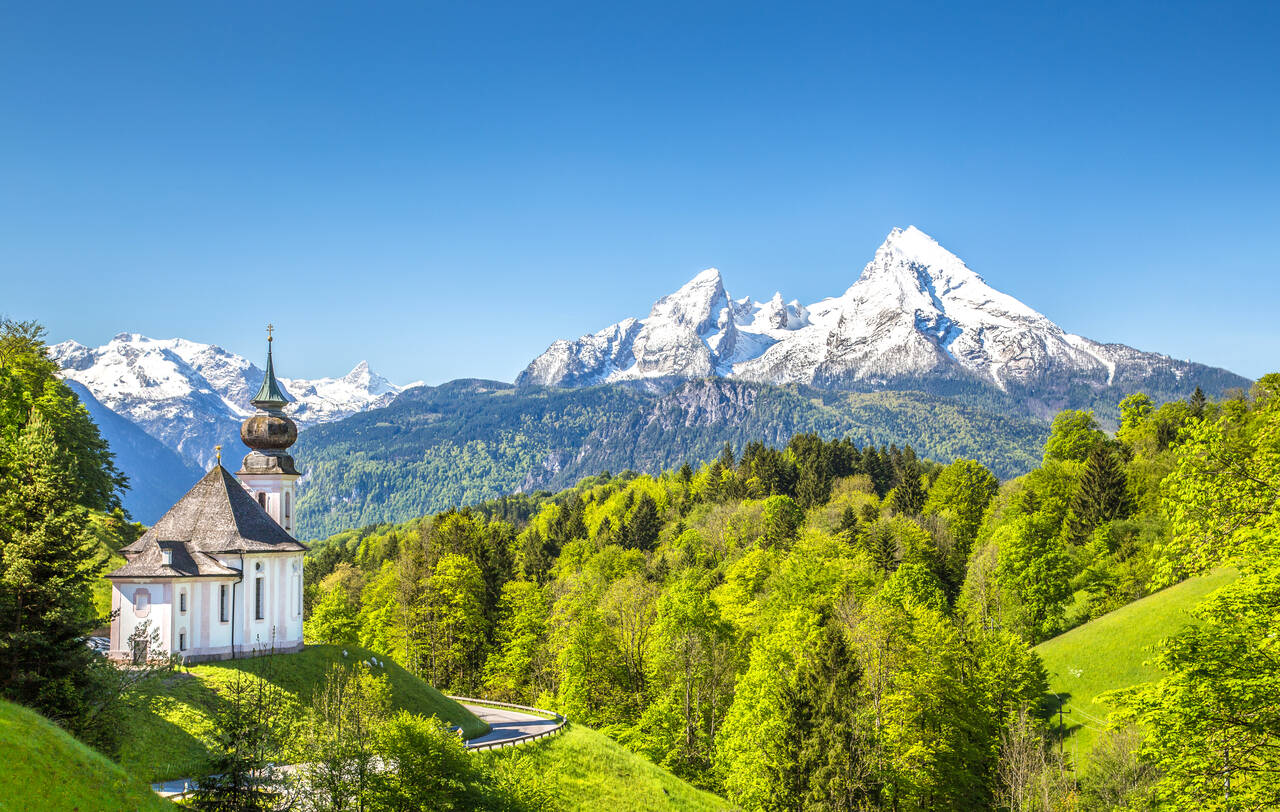
The last phase of the German Alpine Road has begun. Via Inzell (where one finds a glacial garden), we travel up to the Schwarzbachwacht-Sattel where the Alpine Road again becomes a magnificent panoramic road: It offers wonderful views of the Reiter-Alpe, the Hochkalter and the Watzmann massif, but also downwards toward Bad Reichenhall.

The road leads in a curvy fashion down into the Ache Valley where the lively city of Berchtesgaden awaits us after 8 kilometres of going upwards and downwards. Berchtesgaden not only has a quite varied history, but has a cityscape which is constantly going upwards or downwards. Again and again, the old city centre with its church and castle are of great interest in Berchtesgaden. The Augustine cloister, which was founded around 1100, was transformed into a castle and became the summer residence of the Bavarian kings in 1818.

For the church and the castle, one found precisely a level little piece of ground upon the hill, but then one must climb down into the valley to Ache where the entrance to the underground salt domes begin which gave Berchtesgaden its riches. Salt, known as “white gold” in the Middle Ages, was a guarantee for prosperity and independence in this region which includes above all Bad Reichenhall. One can even today still travel into the old mine. The rich people lived from salt, the poor lived from wood.

The “historical sites” upon the Obersalzberg appeal to above all the Americans, the French and the English. The Berchtesgaden Golf Club also is found here in a dreamy locale. The nine-hole golf course lies at ca. 1,000 m above sea level and insiders consider it to be a jewel. Playable challenges require complete concentration, although one could well be a little distracted by the panoramic view of Watzmann, Kehlstein and Berchtesgaden. Golf experts consider the course to be one of the most beautiful in Germany, perhaps as the most beautiful with regards to nature.

Where the Alpine Road ends with golf – in Marktschellenberg, a few kilometres from the summer residence of the kings, at Königssee –, the road of the residences begins after a short distance and with great golf – lucky Bavaria – lucky golf tourists.

Photos

Munich - Oktoberfest

Nuremberg

hills

bavarian food

Lake

Courses

We found 189 Golf Courses in Bavaria:

Golfanlage Königstein

D-92281 Königstein

18 Hole

PLAYMOBIL-Golf Range

D-90513 Zirndorf

Range

Golf Packages - Bavaria

Das Ludwig Fit.Vital.Aktiv.Hotel

Bad Griesbach, Germany

Package: 2 Nights HB and 2 green fees
Dates available: 1.4. - 31.10.2012

from EUR 299,- per person

Maximilian Quellness- und Golfhotel

Bad Griesbach, Germany

Package: 4 Nights HB and 3 green fees
Dates available: 15.3. - 30.10.2012

from EUR 599,- per person

Fürstenhof Quellness- und Golfhotel

Bad Griesbach, Germany

Package: 4 Nights B&B and 3 green fees
Dates available: 1.4. - 18.10.2012

from EUR 499,- per person